
Did you know that the brain can’t tell if a fear is real or imagined?
As a result, we can trigger a fear response with our thoughts. Think of when you have a scary dream. Your body responds as though it is really happening.
If we don’t feel safe, whether in our dreams or just crossing the street, that feeling of fear will stimulate the amygdala, the anxiety-stimulating centre of the brain.
When we’re activated, feeling anxious, or constantly “doing,” we are action mode. The part of the brain that involves learning is not engaged and the nervous system is directing all of our resources to focus on fighting or fleeing. This makes it really hard to learn new things and very difficult to heal. We’re not in rest, digest and repair mode. The challenge of being in pain or injured is that the nervous system is activated and in the wrong mode for healing. Only when we tune in to calm down, relax and rest a bit does our system have the chance to recalibrate and switch over to healing mode.
Modern life encourages us to focus outward. We are constantly stimulated by notifications, obligations, information, noise, and endless opportunities to stay busy. It can become difficult to find the “off” switch.
For many people, especially those living with scoliosis and chronic pain, this state of activation becomes normal. It’s what makes it hard to get to sleep, to get comfortable and the source of many other inflammations and health issues.
We Have Forgotten How to Rest
How did you sleep last night?
If you’re like many people I know, the answer may be “not well” or “not long enough.”
Sometimes it’s an overactive mind. Sometimes it’s discomfort. Sometimes it’s stress. Sometimes it’s simply difficult to find a comfortable position.
Quality sleep matters. But so does our ability to rest during the day.
These are two sides of the same coin.
The ability to slow down, regulate ourselves, and settle our nervous system helps us manage stressful situations, maintain perspective, and support overall health.
Many of us were introduced to yoga primarily as physical exercise. We learned poses, perhaps a breathing practice, and maybe a short meditation.
What is often missing is the inward experience.
Restorative yoga was developed to help us slow down and consciously rest.
We are busy human “doings” rather than human “beings.”
Taking resting poses may be just as important as active poses, particularly if the rest of our lives are filled with activity.
Why Restorative Yoga Is Different
People often ask how restorative yoga differs from other slow styles of yoga, including yin yoga.
In yin yoga, the emphasis is on opening areas of the body such as joints, fascia and ligaments using “healthy stress.” Poses are held for extended periods of time to encourage changes in the soft tissues and improve flexibility.
In restorative yoga, the goal is different.
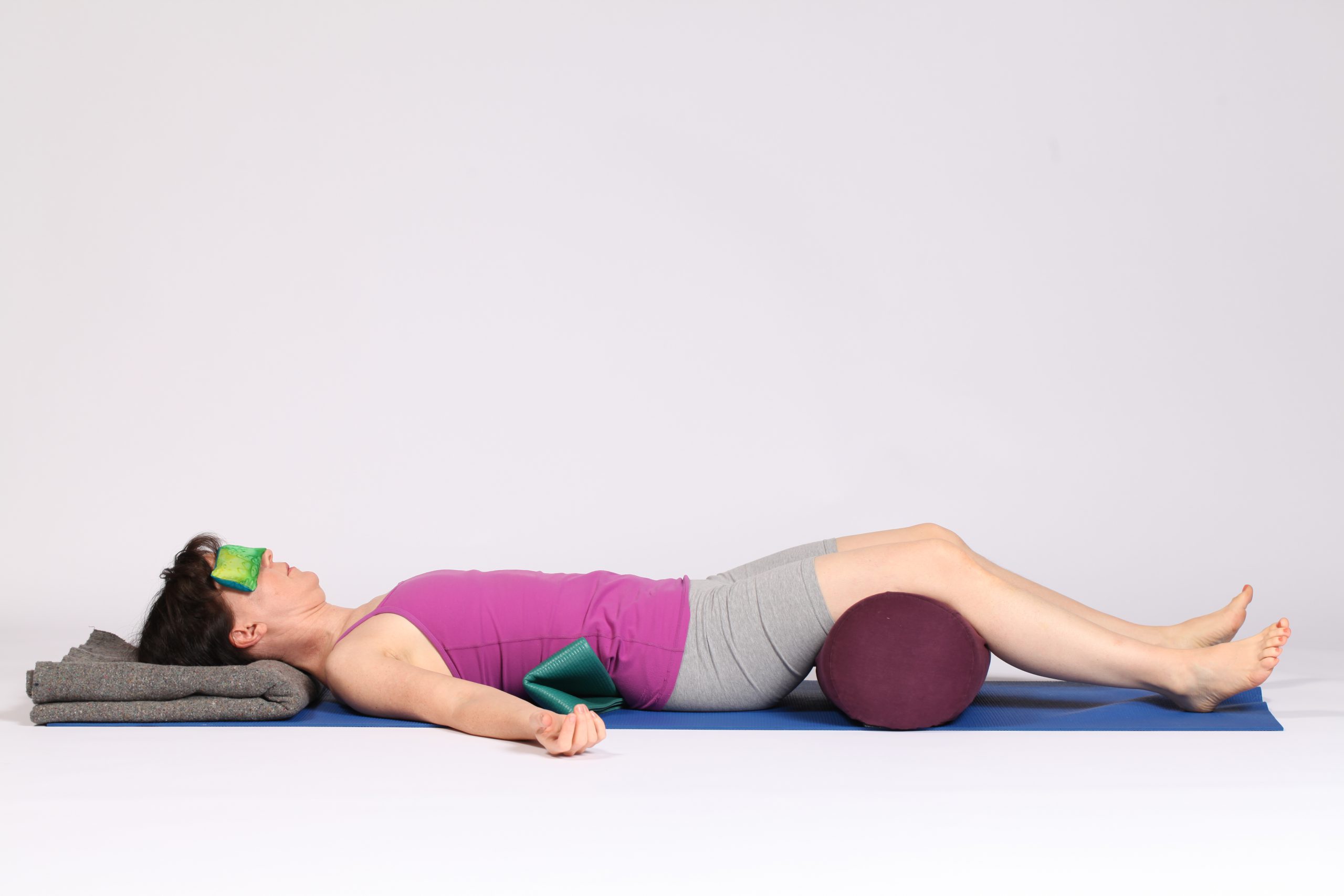
Several props are used to support the body completely. The aim is to get comfortable and rest with minimal effort and without any sensation of stretching.
Many people with scoliosis do not realize how much effort they are using all day long simply to hold themselves upright.
Restorative yoga provides an opportunity to stop working so hard.
There is no need to hold anything in place. No need to strive for alignment. No need to push.
You can simply exhale and soften.
Both yin and restorative yoga are often practiced in warm, quiet environments and at a slow pace. Both encourage us to reduce sensory stimulation and go inward.
However, because many people with scoliosis also experience hypermobility, I generally prefer the restorative approach. The additional support can reduce strain on sensitive joints and tissues.
When a body is already in pain, even healthy stress can sometimes contribute to that pain. Restorative yoga keeps that risk to a minimum.
Creating the Conditions for Deep Rest
Restorative yoga is not about stretching.
It is about creating the conditions that allow the nervous system to settle.
The room is often warm and dimly lit. Blankets, bolsters, blocks, eye pillows, straps and other props support the body.
The positions are designed to be comfortable enough that the body no longer feels the need to brace, grip, or hold.
The Reticular Activating System (RAS), a part of the brain involved in alertness and attention, is highly sensitive to discomfort.
Noise can activate it.
Touch can activate it.
Discomfort is often the strongest trigger.
When the body becomes comfortable and supported, this system can quiet down.
The muscles no longer need to work.
The mind becomes quieter.
The body can begin to receive support.
Can Restorative Yoga Help with Scoliosis?
Many people ask whether restorative yoga can help reduce scoliosis pain and tension.
The answer is yes, provided the practice is adapted to the individual and appropriate props are used.
The selection of poses, sequencing and breathing practices all play a role.
During restorative practice, we have an opportunity to soften areas that work hard all day long.
We also give the tight concave areas a chance to be supported and rest. This means they are less likely to grip or go into spasm.
Using the props and exploring the differences between the two sides of the body increases our body awareness and gives us useful information to take into our daily movements. This helps us reduce the chances of reinforcing our curve pattern unconsciously.
The resting practice gives us a chance to release old holding patterns and create space for new postural patterns that are more balanced.
People also ask whether restorative yoga can help with stress and anxiety.
This is one of the primary aims of the practice.
By slowing down and bringing awareness to the present moment, we begin to notice the “what if?” thoughts that often fuel anxiety.
We learn that we are more than our thoughts.
We do not have to believe every thought we think.
For many people this realization brings tremendous relief.
Another common question is whether restorative yoga can improve sleep and fatigue.
Restorative yoga helps us learn how to get comfortable.
It teaches breathing practices that encourage the body to shift into rest and digest mode.
It gives us opportunities to practice making these shifts consciously.
It allows us time to explore different ways to make our bodies comfortable.
Later, when we need to rest during the day or settle at bedtime, we already have tools available.
For people with scoliosis, learning how to support the body according to their curve pattern can help relieve tension in compressed areas and reduce the feeling of fatigue that comes from constantly working against gravity.
Sometimes the Missing Piece Isn’t Another Workout
Recently I spoke with a woman with a large scoliosis curve.
She was already doing physiotherapy, Pilates, and swimming.
Yet she was still experiencing pain when active for too long.
She was looking for more “safe workouts.”
When I asked about mindfulness, breathing practices, restorative yoga, philosophy and body awareness, she went quiet.
Many people come to me like this.
They are already doing a lot.
What is often missing is not another thing to “do”.
It is a “work in.”
An opportunity to listen inwardly.
To recognize the body’s signals before pain develops.
To notice when we are overdoing it.
To hear the wise inner teacher that is often drowned out by activity and noise.
The Practice of Doing Less
Getting quiet and physically comfortable allows the nervous system to recalibrate.
A restorative practice can be a revelation.
It literally gives us breathing space.
If we set the intention to release tension and soften habitual holding patterns, we begin working with those patterns instead of reinforcing them.
Much of this process happens beneath conscious awareness.
We can be awake without gripping.
We can relax without becoming dull.
We can be present without forcing.
To me, this is the essence of yoga practice.
Doing what we do artfully, with awareness and without force.
The body does not respond well to force, especially when we are working with injuries and/or patterns that have been present for years.
Imagine for the restorative session that your only task is to get comfortable enough to let go.
Nothing to fix.
Nothing to organize.
Nothing to plan.
Nothing to perform.
Just breathing, resting, receiving support, and allowing your body the opportunity to remember what relaxation feels like.
Sometimes the most powerful thing we can do for healing is less.
Not more.
To find out more about yoga and scoliosis, go to this page.
To book a private yoga session for yourself, go to this page.
